World on a Wire (1973)

It’s funny: the two RWF movies I’ve dreaded watching the most, The Bitter Tears of Petra von Kant and World on a Wire, turn out to be my favorites so far. But if I dreaded the first movie, it’s largely because of what I actually remembered about it (suffocating masochism in a single interior space, anyone?). My fears about World on a Wire, on the other hand, were based solely on assumptions, sheer conjecture. You can understand my apprehension: a science fiction movie made for television in Germany in 1973 lasting over three hours? Visions of Tarkovsky—to whose work I feel a genuine aversion, having fallen asleep in both Solaris and Stalker. (And, yeah, I do know how incredibly uncool an admission that is). Come to think of it, I also fell asleep in 2001: A Space Odyssey. Maybe I just don’t like science fiction?

World on a Wire was a genuine surprise. It works. It’s really engaging as a genre movie and it holds its own as cinematographic art. Fritz Müller-Scherz’s script, adapted from a novel by Daniel Goulaye, is tight. The cinematography is stunning (Michael Ballhaus, natürlich), enhanced by the 2010 restoration available on Blu-Ray from Criterion. The art direction, partly by Herr R himself (Kurt Raab!), is just fabulous. It’s a gorgeous movie.

In a nonspecific future (which is really the present) the IKZ Institute is finalizing a project called Simulacron, whose purpose is to create a computer-generated world inhabited by computer-generated people, “identity modules” whose behavior patterns can be accelerated and studied, permitting governments and conglomerates to predict actual consumer behavior in the future and so make hugely profitable investments in the present. When the project’s lead scientist, Vollmer, mysteriously drops dead after suffering a sort of breakdown, his second in command, Fred Stiller (Klaus Löwitsch), is promoted to technical director. This is a big promotion for Stiller and he is proud of it.

Things are not as they should be at IKZ, however, and Stiller grows increasingly uneasy. The circumstances of Vollmer’s death are murky, confounded by the sudden disappearance of the head of security, Gunther Lause (Ivan Desny), from a crowded party at the home of the director of the institute, Siskins (Karl Heinz Vosgerau), right before Lause was about to disclose something really important to Stiller about Vollmer’s death and about Simulacron. Stiller files a police report, but suddenly nobody has ever even heard of Gunther Lause, as though he never existed. Stiller’s trajectory begins to mirror Vollmer’s as he realizes just how far the Simulacron project has advanced and how enmeshed in its multiple realities—the boundaries between which he can no longer distinguish—he really is. Who can he trust? Who and what is even real? The periodic pounding in his head, which Vollmer complained of before collapsing, grows, as does the high-pitched electronic screeching that accompanies it.

World on a Wire clearly predicts The Matrix, to which it is frequently compared. Both depict virtual realities that seem more real than real—to the point where viewer and protagonist alike are forced to question the nature of reality itself—and both invoke philosophical conundra about the role of perception and notions of the real. (World on a Wire directly references both Zeno’s Paradox and Plato’s cave.) Whereas The Matrix relies on CGI and state-of-the-art effects to accomplish this, however, RWF creates and sustains coherent virtual world(s) with . . . lenses. And sound effects. For me, the low-tech nature of the effects in this movie actually make it more powerful and more engaging. Not to mention the philosophical questions the film poses, which are orders of magnitude more cogent and compelling than anything the Wachowskis have come up with.

In many ways, the more apt comparison here is with Alphaville. (Eddie Constantine, Alphaville’s Lemmy Caution, even has a small role in World on a Wire.) Like Godard before him, RWF uses the landscape and architecture and imagery of contemporary Paris to depict a future dystopia, which is alienating precisely because it is familiar. There are no silver bodysuits, no robot sidekicks, no spaceships. Just lonely International-style highrises looming in a barren landscape, 1970s-modern furniture you could find at any Design Research store (anyone else remember DR? I’m dating myself, I know), lots of bright-colored plastic, mirrors, computer banks, TVs. That future we all fear? It’s already here.

At the same time the world(s) depicted in World on a Wire are outside time. There is a wonderful scrambling of styles that suggests a mix-up of eras. When Stiller has himself projected down into the world of Simulacron, for example, the dominant style of the décor and fashion is from the 1930s. Eva Vollmer (Mascha Rabben, in a role originally offered to Hanna Schygulla), Stiller’s former boss’s elusive and mysterious daughter, dresses like a femme fatale straight out of Chandler. A Dietrich impersonator performs at Siskins’ party. “Lili Marleen” accompanies a film of jackbooted Nazi era troops on stage at the Alcazar where Stiller flees later in the film. Simulacron, in other words, is outside time. But there’s more to it: the simulated world(s) of Simulacron evoke not the world of contemporary Germany, but imagery most viewers will have remembered from the movies. I think they also suggest historical memories repressed and largely erased from the collective memory in Germany after the war. This is no coincidence. Erased or deleted memory is a central theme in World on a Wire.

As far as I know, World on a Wire was RWF’s only foray into the realm of science fiction. Somewhat paradoxically, this futuristic tale evokes the 1970s more strongly than any of his films that were actually set in contemporary Munich. Watching it I felt a real sense of nostalgia. This may seem counterintuitive. But there is an overt distancing effect in the contemporary stories that renders them sort of timeless. I think you notice the way RWF rejects realism in the stories of quotidian life—films like Katzelmacher or Why Does Herr R Run Amok or The Merchant of Four Seasons—more than you do in World on a Wire, set as it is in a world not quite like our own. (To a certain extent I think we are conditioned—hardwired even—to expect a certain transparency, a certain familiarity, from stories that take place in the everyday world; we expect, if only unconsciously, to identify with the characters as everyday people. That’s how mimesis works. When a work doesn’t deliver the experience we expect, we take notice.)

But that doesn’t really explain the deep nostalgia for the 1970s World on a Wire provoked in me. How about this: A genre film carries with it certain conventions, which are hard to shake; they give the work a certain context. They are a product of culture, which is always specific. (Maybe that’s why I didn’t like Solaris: maybe Tarkovsky rejected so many genre conventions that I couldn’t make sense out of it?) By necessity, even visionary artists view imagined futures through the filter of their own place and time, through culture; moreover, they are bound to use the tools available to them in that place and time. So that the imagery—the plastic furniture, the screaming tangerine telephones, the computer screens, the architecture—as well as the cinematic “language”—the camerawork and the editing, in particular, but also the depth and resolution and contrast available with specific film stocks and optics—cannot but date the work, no matter how visionary the artist, no matter how innovative the techniques.* Which may simply be to say, World on a Wire looks and feels like a futuristic movie made in 1973.

Which is not to say that World on a Wire is not every bit as “alienating” as, say, Katzelmacher. According to the documentary included with disc 2 of the Criterion DVD—definitely worth watching, BTW, even if the central premise (RWF “predicted” virtual reality) seems a little lame—many of the actors cast in this film were famous German movie stars from an earlier generation whose heyday had passed. For the television audience of 1973 this added both a layer of familiarity and a degree of strangeness (what is he doing there?). Which actually mirrors Stiller’s own experience within the film. Ditto the use of simple optical tricks and motifs: the ubiquitous mirrors and glass tables fragment and reflect the characters and underscore the sense that they are merely images. Ballhaus describes how he achieved the effect of the opening shot of the film, in which the Secretary of State pulls up to IKZ headquarters: shot with a 250 mm lens so that space is collapsed and depth of field and focus practially nonexistent, he seems to recall that they may have also used a bunson burner below the lens to add a swirling effect and further undermine the solidity of the image. Reality is just a shimmering mirage in the distance.

I was eleven in 1973. I try to imagine what it must have been like for a kid my age to have turned on the television after dinner and seen World on a Wire instead of, say, McMillan and Wife or Police Woman. It must have been mind-blowing. This is what impresses me more and more about Fassbinder: as an artist he was a true egalitarian, a journeyman as well as an arthouse cult hero, who could transition from The Bitter Tears of Petra von Kant to World on a Wire and see no contradiction between the two.

****************

* Take the zoom, for example. Remember in the late ’60s and ’70s when everybody started using the zoom to convey emotions like sudden surprise or shock or anxiety? (I always think of the Italians in connection with this: Pasolini, Visconti, Lina Wertmuller . . . ) Today, the technique is cringe-worthy, it’s so out of fashion and dated. Why is that? Is there something inherently cheesy about the zoom? And if so, what? And if not, why did it go so completely extinct? This is a topic for another post entirely, but I doubt I’ll have time. In the meantime: let’s bring back the zoom and see where it takes us!
Posted in 1970s style, German Cinema, Rainer Werner Fassbinder | 1 Comment

The Bitter Tears of Petra von Kant (1972)

As you might expect, there are a couple of RWF movies I’ve been really dreading, some because they’re really slow and static, others because they’re just emotionally brutal and depressing. The Bitter Tears of Petra von Kant has been at the top of that list, frankly, because it’s all those things. That, at any rate, is how I remembered it. What a difference fifteen years and eleven early Fassbinder films under your belt makes!

Don’t get me wrong. The movie is still excruciatingly slow and suffocating, and the story of a masochistic affair between two women (OK, three) is almost intolerable both for its cruelty and its display of raw emotion. But wow. What a tour de force. This movie is just amazing.

Petra von Kant (the skeletal Margit Carstenson) is a successful fashion designer, recently divorced, who lives in her studio, or atelier, or whatever you call it, with her devoted assistant/servant, Marlene (a mute Irm Hermann). An aristocratic friend, Sidonie (Katrin Schaake), introduces Petra to a charming and beautiful acquaintance, Karin (Hanna Schygulla), who wants to break into fashion modelling. Petra is immediately smitten. Act II ends with Petra inviting Karin to come live with her and promising to make a successful model out of her.

By Act III the relationship has already degenerated past the point of no return: Karin tortures Petra with her obvious indifference and detailed descriptions of her infidelities, while Petra, who appears to subsist exclusively on gin, alternates between powerless rage and pathetic desperation. When Karin’s husband from Australia phones unexpectedly, Karin demands that Petra buy her a first-class plane ticket so she can meet him in Frankfurt. Petra, drunk, orders Marlene to drive Karin to the airport.

Act IV sees Petra at rock bottom. She lies on her postmodern white carpet (the word shag does not begin to do it justice; it’s more like ostrich or some very long-haired snow-white animal) with the telephone and a bottle of gin, waiting for Karin—now a successful model—to call and wish her a happy birthday. Sidonie, Gabby (Petra’s daughter, back from boarding school), and Petra’s mother all show up, but Karin does not. As the scene unfolds, Petra comes spectacularly, pyrotechnically unglued.

The Bitter Tears of Petra von Kant is kind of a perfect film, in a small, self-contained way. Cold, formal, precise, it is almost crystalline, like a snowflake or a pavé diamond. To me it’s the culmination of RWF’s work in modernist theatre combined with his ongoing preoccupation with the politics of sexuality, and, of course, melodrama. This strange hybrid form was not new to him, of course; by 1972 RWF had already made plenty of movies that combined extreme formalism with elements of melodrama or other genres. But those threads never really quite meshed. The early films, from Love Is Colder Than Death to Rio das Mortes, all suffer from a jarring, unresolvable sense of incongruity, as though the parts, however interesting intellectually (and they are always interesting intellectually, if you ask me), don’t quite add up to a coherent whole. This film is different.

The movie is technically beautiful. Set and shot entirely within the confines of Petra’s studio, which for all intents and purposes consists of one room with other adjoining spaces visible through framed openings, it is literally theatrical (I’m thinking it was written to be staged as a play?). Unlike many interior dramas, however, Michael Ballhaus’ camera work makes this narrative confinement strangely thrilling. There is more camera movement than we have seen in any of the previous films (except maybe Herr R, but that was more of a handheld thing), and that movement is stately, masterful, beautifully choreographed with the actors, so that the latter are framed and reframed in a series of very stylized and often highly symbolic compositions. I think I read some description of the film somewhere that described it as consisting of a series of long, mostly single takes. That’s not quite true—the takes are long, but there are plenty of cuts, too. I think the editing and the cinematography work so well together that they appear nearly seamless—which may seem paradoxical, since the film itself is highly formal and self conscious, but it’s not, really. Fassbinder heightens your awareness of only the artifice he wants to make you aware of. This is the work of a director at the top of his game.

In addition to that groovy carpet, the set is fantastic. The central room, with only a bed in the center, is bisected by open frames (as in window-like studs and beams), which enable views of the adjoining spaces while framing characters, especially Marlene, who works in the space next to Petra’s room, in gorgeous depth. An entire wall of Petra’s room is adorned with a huge, really impressive renaissance-style mural depicting a Greco-mythological-type bacchanale. [According to a review on IMDB, the painting is Poussin’s Midas and Bacchus, adding another layer of symbolism: gold and wine, money and pleasure, acquisition and abandon?] Along with the costumes, which I’ll get to in a minute, and of course the super-formal compositions and tracking shots, it reminded me of Peter Greenaway, especially The Cook, The Thief, etc. Yet another example of just how far ahead of his time Fassbinder was.

The costumes: over-the-top fabulous. (Why did I not remember this?) The conceit of having Petra be a fashion designer enables RWF to really play up the artifice with which she presents herself to the world (and herself). The Salomé/Theda Bara/Klimt-y-style getup that Petra sports to seduce Karin is just unbelieveable, but all the outfits and make-up are pretty spectacular. There are a lot of collars trimmed in fur or feathers (plumage! of course!), and Petra changes her wig with every outfit. Marlene’s 1930’s-inflected black dress, bobbed hair, and pert red lipstick are perfect.

Clothing, hair, and make-up are the most obvious ways Petra constructs her image of herself as cultured, sophisticated, commanding, and in control, but they’re not the only ones. There is something Olympian about her self-image, something godlike. (Perhaps that’s the significance of the mural?) She treats Marlene like the lowly slave she considers her to be, and it never occurs to her that she won’t be able to utterly possess Karin—her protégé, after all, her discovery—who comes from a tragic working class background. Who with such humble origins wouldn’t jump at the chance to be loved by a goddess?

Petra believes that she is above the petty politics and crass negotiations that characterize ordinary relationships. She is not interested in the “codes of behavior” and all the tiresome little “tricks” women employ to keep their relationships with men alive. Petra wants only true, honest, transcendental love, the kind that must be reinvented daily and which eludes mere mortals like her friend Sidonie. Petra claims that she divorced her husband because he couldn’t handle not being “on top” once her career became more successful than his. This sounds reasonable in a good feminist sort of way, but it probably just means that she could not tolerate his unhappiness, or any such ordinary human emotion. Great love does not permit such pettiness, which anyway wasn’t part of her design.

I haven’t talked about the lesbian angle yet, for good reason. I think it’s largely beside the point, except insofar as it confirms my assertion that relationships in Fassbinder’s universe are really about power, of which gender is but one signifier. Quite often class is actually the more important factor, which is what we see here—more clearly because there are no men and so no gender politics to complicate things. Petra tells Karin early on that she is grateful to her parents for exposing her to beauty and the finer things in life as a child, which is of course a statement of pure privilege (Karin had no access to fine things of any kind). And Petra quite simply owns the voiceless Marlene, whom she treats like the subservient dog she appears to be.

But class—or money, or gender, or violence—only keep you on top for so long. Once you fall in love in Fassbinder’s world, all bets are off. Thus does Petra lose the upper hand to Karin—whose indifference to Petra’s increasingly abject devotion ensures her triumph. This is why Fabian had no power over the indifferent Berta in Pioneers in Ingolstadt, too, despite his superior standing in terms of gender, wealth, class. This may also explain why prostitutes fare so well overall in Fassbinder’s world: it’s all just business. In film after film after film, RWF makes the same point: to fall in love is, quite simply, masochism. And of course the very definition of masochism is pleasure in pain (if the masochist didn’t cherish his suffering it wouldn’t be masochism, it’d just be victimization). In Pioneers, Berta begs Karl to lie to her rather than leave her. Petra asks Karin to do the same thing, even though she’s too savvy to fall for it, which only increases her pain. (Oh, and remember that scene in Whity when Whity is whipped by Nicholson? Definitely masochism!) But perhaps the ultimate masochist is Marlene. Not only is she clearly in love with her employer, it becomes evident that she cannot tolerate the prospect of any other kind of relationship with her. For once, I don’t want to spoil the ending, but suffice it say, Marlene offers perhaps the purest and certainly the most puzzling manifestation of masochism we’ve seen in Fassbinder so far.

There is a curious dedication after the opening credits of Petra von Kant which reads, “To the one who became Marlene here.” According to Jane Shattuc, who does the audio commentary on the DVD (I listened to about 20 minutes of it—it’s kind of interesting but not earth shattering, IMHO), RWF was downright abusive of Irm Hermann throughout their working relationship; casting her in this role with this dedication was his way of acknowledging that. It is also a reminder of who actually wielded the power in Fassbinder’s world.

Posted in 1970s style, German Cinema, Melodrama, Rainer Werner Fassbinder | Tagged , , | Comments Off on The Bitter Tears of Petra von Kant (1972)

The Merchant of Four Seasons (1971)

I’ve been picturing some kind of Venn diagram to categorize Fassbinder movies. The Merchant of Four Seasons, for example, would fall within at least two circles (probably more than that, but two’s a good place to start): stories of Men Driven to Despair by Bourgeois Society and stories in which Male Friendship Trumps Heterosexual Relationships. But then so would most of the movies I’ve talked about so far. (Other obvious RWF categories spring to mind: Masochistic Relationships is a good one, and so is Chauvinism and Prejudice, etc.) I like this idea a lot and may experiment with the idea soon. It appeals to my relentless desire to classify and my compulsive need to generalize from the particular. There is also something inherently funny to me about Venn diagrams, which might help ease the weight of all this wrenching drama—I’ve still got several dozen of these damn things to watch, after all. And anyway, Fassbinder’s work really does lend itself to this. The guy really did make a handful of movies over and over and over.

Of course this kind of classification is also pretty reductive: in cramming these movies into neatly labelled boxes, we ignore the particulars that make each film that unique film, for the sake of broad, often abstract, ideas. Who cares, for example, that The Merchant of Four Seasons mirrors Why Does Herr R Run Amok? in terms of central theme (a soul stifled and crushed by bourgeois society), character elements (a judgmental mother figure, most notably), and final outcome (suicide)? What makes TMoFS interesting is not so much what it shares with the earlier film but how it differs from and moves beyond it. Because the later film really is so much richer, more complex, and more sophisticated, both thematically and technically. In fact, I think it marks RWF’s arrival as a mature filmmaker.

Hans Epp (Hans Hirschmüller) is a pathetic wretch of a man. Despised by his haute bourgeoise mother, he joins first the Foreign Legion, then the police force—from which he is fired for receiving sexual favors from a suspect, presumably a prostitute—and finally settles as a green grocer, hawking pears (or plums or tomatoes) from a barrow in the streets of Munich. He has a wife, Irmgard (played magnificently by Irm Hermann, against her usual type); a somewhat neglected daughter, Renate; a sister, Heidi, who holds him in the same contempt as their mother does; and another sister, Anna, who does not (played by Hanna Schygulla, also refreshingly cast against type). Heidi’s husband (Kurt Raab) is a prim and successful newspaper editor who stands as a counterpoint to Hans, a constant reminder of the latter’s failure. Ingrid Caven plays the love of Hans’ life who rejected him as a suitor because of his lowly trade; she hovers about the neighborhood like a slightly creepy spectre, another reminder of Hans’ failure. Not surprisingly, Hans tries to escape his miserable existence through alcohol. Eventually he succeeds.

Despite the simplicity of the above description, this movie is morally complex and maddeningly ambiguous. Hans is a victim of sorts, but his wallowing and drunken cruelty toward his wife are really distasteful. He neglects his duties to drown his sorrows at the local bar, then humiliates his wife when she comes looking for him. When he finally stumbles home, blind drunk, she criticizes him, so he beats her in front of their child.

Irmgard, for her part, is certainly a victim, but not a terribly attractive or sympathetic one. (Irm Hermann comes across as a sort of vaguely malevolent porcelain doll). While Hans is in the hospital following a heart attack, Irmgard brings a stranger (Karl Scheydt) home for some recreational sex, only to be interrupted by her unfortunate daughter. Later, through sheer coincidence, Hans will hire that same man, Anzell, to work the barrow for him (doctor’s orders: no strenuous work and no drinking after the heart attack). In an effort to avoid exposure as an adultress, Irmgard tricks Anzell into stealing from Hans so that he will be caught and fired.

Enter Harry, Hans’ old Foreign Legion buddy (Klaus Löwitsch, in what would surely have been Gunther Kaufman’s role had this film been made earlier). Through sheer happenstance the two reunite just as Hans is looking for an employee to replace Anzell. Harry cheerfully accepts and moves into the Epp household, where he proves to be far more capable than Hans. While the loyal Harry manages the business, provides chaste companionship (!) for Irmgard, and helps Renate with her homework, Hans sinks into a deeper and deeper depression, which culminates in a final ceremonial series of whiskey shots, each perversely dedicated to someone in his life. (The climactic flashback to Hans’ time as a legionnaire in North Africa features El Hedi Ben Salem—Ali in Fear Eats the Soul)—and a whip. Enough said?)

As with the tragedy of Herr R, the problem here isn’t simply oppression. Hans shows absolutely no initiative and no capacity to envision a different kind of life for himself. Just as he was unable to say no that fateful night in the police station that cost him his career, he is dully passive, his only outlets alcohol and wife-directed violence—the province of powerless men the world over. He is really the victim of his own self-hatred and lack of imagination. (Here any Marxists in the audience might wish to point out that this is precisely how “bourgeois ideology” works: men internalize it and then blame themselves when they don’t live up to its impossible standards. Or something like that?)

Ach, so. Aside from some familiar faces in new roles (Hermann, Schygulla, Löwitsch, and  Raab all play wonderfully different characters from their last RWF movies) what’s new here? The script, for one thing, marks a pretty big shift towards a more complex (and in some ways more conventional) narrative structure compared to the more minimalist and theatrical style of the earlier films. Here, for example, RWF uses flashbacks, which add a new depth. The camera, too, feels freer and more confident than in the earlier movies; the cinematography is more sophisticated and also more naturalistic than in any of RWF’s previous color films (Whity, Pioneers in Ingolstadt, etc.), and there’s literally more depth to the images. The interiors are as suffocating as ever (I swear, every RWF movie uses the same kitchen), but the exterior cinematography, while still stylized, feels both more open and more integral to the narrative, more immanent, which is to say, the cinematography “colors” the film and underscores the thematic and emotional content in ways that seem new. Hans, for example, spends his days negotiating within cement and stone courtyards, surrounded on all sides by drab lace-curtained apartment windows (what’s the opposite of a panopticon?), that open one onto another (the courtyards, not the windows). These are shot as a series of planes and interconnected cubes, like some kind of quotidian labyrinth in which the fruit merchant is trapped, the geometry of prison.

So: instead of the monotone flatness of the early films, spatial and temporal depth. To me, this is a real sign of Fassbinder’s growing confidence as a film director. More certain now of his abilities, he deploys a wider range of cinematic tools to his own ends. No more hiding behind avant-garde minimalism. This is the Fassbinder we talk about when we talk about Fassbinder.

Posted in German Cinema, Melodrama, Rainer Werner Fassbinder | Tagged | 4 Comments

RIP Gunther Kaufmann (1947–2012)

A few weeks after I watched Whity this spring, Gunther Kaufmann died suddenly of a heart attack in Berlin. He was 64. May he rest in peace.

This is not earth-shaking news, of course. Many of Fassbinder’s collaborators are long dead, after all. And we’ve had 30 years to get used to Fassbinder’s own death—as well as 30 years to celebrate him. But Gunther Kaufmann? I had only just begun to appreciate him.

I had never heard of Gunther Kaufmann until I began this project. I knew him by sight, of course—didn’t we all?—as the hunky black GI from The Marriage of Maria Braun, but that’s about it. [In fact, it isn’t. Kaufmann did not play “the hunky black GI in Maria Braun;” that was just my lazy, stereotypical assumption nearly 35 years after the fact. Kaufmann had a much smaller role in the film.]  I certainly didn’t know his name. But after watching him in six films made between 1970 and 1971 (!) I have come to see him as utterly central, if only briefly, to Fassbinder’s universe. As important, for a time, as Hanna Schygulla was to RWF’s oeuvre.

Bavarian and black, Kaufmann was the son of a German (mother) and an American GI (father) stationed in Munich after the war. An oddity and an outsider by definition, especially in a society that had less than 30 years previously defined itself in terms of racial purity, Kaufmann was tailor-made for Fassbinder. Add to this a truly impressive physique and an apparently omnivorous sexuality and you have a match made in heaven.

Of course it didn’t last—these things never do. Pioneers in Ingolstadt was the last movie Kaufmann made with Fassbinder until 1978, when he appeared in several late RWF films (most notably Maria Braun). Interestingly, the Fassbinder Foundation obituary says that Kaufmann took a break from acting after Pioneers, but a glance at his career history suggests that he just took a break from Fassbinder. (It seems the two were romantically as well as professionally involved. Small wonder Kaufmann needed a break.)

The last years of Kaufmann’s life were not easy. His career faltered, especially after he became embroiled in a bizarre stranger-than-fiction intrigue in 2002 when he falsely incriminated himself in the extortion and murder of his accountant to protect his wife, who appears to have been guilty but who was dying of cancer at the time. (Kaufmann served time in prison before new evidence exonerated him.) He published an autobiography in Germany several years ago and was set to participate in a film about his life when he died.

It seems almost beside the point to mention that what made Gunther Kaufmann so compelling was not his skill as an actor, at least not in the conventional sense of the term. In a highly self-conscious theatrical universe, intentionally devoid of affect or traditional emotional identification, Kaufmann exuded pure energy, like some elemental source of electricity, a kind of vital center in an otherwise barren and artificial landscape. With his massive physique (which his clothing seemed barely able to contain), his opaque and irresistable grin (often at odds with the demands of the story), and his air of perpetual good nature (even as his character might be beating another man to within inches of his life), Kaufmann often seemed about to burst—out of his clothes, out of the confines of the narrative, right out of the film frame. Not so much larger than life, but larger, on some level, than art.

Posted in German Cinema, Uncategorized | Comments Off on RIP Gunther Kaufmann (1947–2012)

The Niklashausen Journey, Rio das Mortes, and Pioneers in Ingolstadt (TV Movies 1970-71)

As mentioned in a previous post, it turns out that three of RWF’s movies made for German TV in 1970-71 are now available on DVD, thanks to the Fassbinder Foundation. So back to 1970 we go—so much for chronological order and linear momentum. But this might actually be a good thing, even if it’s not how I set out to do it. Given the circular nature of Fassbinder’s own trajectory—he obsessively returned to the same themes and motifs in a slightly different, more developed form even after appearing to have exhausted them—the spiral might just be the perfect path to follow. In any case, I’m glad I watched these. Each, though minor in the context of RWF’s larger body of work, embodies some major thematic preoccupation that informs the later “big” movies. And each has helped me to make a little more sense of those preoccupations. Sometimes it’s the smaller, seemingly insignificant pieces of a puzzle that, when placed, enable you to see the larger pattern more clearly.

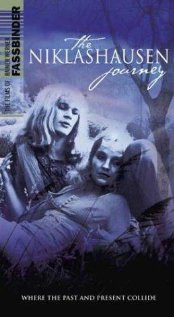
The first of these, The Niklashausen Journey (1970), is the most unusual and, though tedious and pretty dated in its political rhetoric (and not all that much fun to watch), intellectually the most interesting. This is an agit-prop historical allegory—not an ounce of melodrama anywhere in sight!—that owes more to Godard and RWF’s own work in avant-garde theatre than it does to Douglas Sirk. In adapting the true story of Hans Böhm, a 15th-century mystic who incited thousands to revolt against the established feudal order after claiming to have been visited by the Virgin Mary, RWF situates revolutionary political activity in the context of desire. This for me was interesting in itself and a relief from the Gunther Kaufmann Love Triangle that has dominated so many of these early films (see below).

ImageThe film opens with the Black Monk (RWF himself, in dirty jeans and black leather jacket) quizzing his fellow cadre members about the theory and practice of revolution (“Q: Who needs the revolution? A: The people. Q: Who makes the revolution? A: The people. Q: Who prepares the ground for it? A: The party.” Etc., etc.). In the next scene we see Böhm (played by Michael König, blond and beatific like some 1970’s rock and roll god), a shepherd and drummer, preaching to the assembled faithful about his revelation from the Virgin Mary who told him to spread her message about the sins of landownership and clerical power and the exploitation of the powerless. Here, the Black Monk realizes, is the perfect mouthpiece for the revolutionary cause: handsome, charismatic, people listen to him. The message is not enough to incite the people to revolt, in other words; the people must desire the messenger in order to act. (Fast forward to 2008—think Steve Schmidt and Sarah Palin—and you get a perverse sense of how prescient Fassbinder was.) And so their campaign begins. When a devout and wealthy (and increasingly hysterical) follower (Margit Carstenson) insists that Böhm move in with her, the Black Monk encourages him to do so—as long as he and his friends can come with him, of course.

But the people are still not quite “getting it.” The Black Monk realizes that the people need a more literal vision of the Virgin Mary’s message (in other words, a miracle) to move them to action, so he grooms his comrade, Johanna (Hanna Schygulla), to appear in the guise of the Virgin when Böhm speaks. This seems to work, for a while. Inevitably, however, the powers that be, in the form of the local bishop (played in glorious high-camp Caligulesque by Kurt Raab, who inhabits a rococo palace surrounded by nubile young men à la Caravaggio, anticipating Derek Jarman by more than a decade), muster their forces against him and Böhm is burned alive at the stake in an automobile junkyard as a mezzo soprano sings the Kyrie Elieson and Gunther Kaufmann shoots the MP-uniformed guards from a VW bus (did I mention Derek Jarman?). Revolutionary fighting continues, led by Kaufman, who seems to represent the praxis-minded guerilla in contrast to the Black Monk’s more strategic and intellectual bent. The film ends with the original cadre, led by the Black Monk, taking the long view (I think). I’m not actually sure where this movie stands on the subject of violent political action, but that ambiguity is precisely what makes it interesting to me. People, the film suggests, cannot be educated or persuaded to free themselves, only seduced. For the revolutionaries, this inevitably leads to cynical manipulation (there’s a great scene in which Johanna practices her lines as the Virgin Mary, working out how best to appeal to the masses: “I should look up here”; “This line needs more humility,” etc.), or self-aggrandizing delusion (Böhm really believes he is some sort of messiah appointed by God), or violent nihilism (Kaufmann’s scorched-earth approach).In any case, I think this movie will be a useful reference when I get to RWF’s later political films like Mother Kusters Goes to Heaven and The Third Generation.

Rio das Mortes (1971) retreads painfully familiar territory. Once again Hanna Schygulla plays Hanna, cruelly abandoned by Michael, the man she loves (Michael König, still looking like a rock god), for Gunther (Gunther Kaufmann, natürlich) in what shall henceforth be referred to as the Gunther Kaufman Love Triangle (Revolving Male Character X + Gunther Kaufmann + Hanna Schygulla = ∆). But whereas the Hanna/Johanna of the earlier movies seemed like a naïve and ultimately innocent victim of her own deep romanticism, this Hanna is not particularly sympathetic. Henpecked by her mother, her sole ambition in life seems to be to get Michael to marry her. She is a paragon of bourgeois values, even if she doesn’t realize it. (She spends a lot of time on her make-up and poses like Dietrich in her Weimar underwear while talking to her mother on the phone.) Small wonder Michael is bored.

For his part, Michael is a naïve and sullen man-child, with limited prospects (he and Harry Baer lay tile for a living). When his old school chum, Gunther, comes back into his life by accident, the two rekindle a boyish plan to escape their humdrum lives for Peru to search for ancient Mayan treasure. The remainder of the movie consists of their efforts to raise the money for the trip and Hanna’s sporadic attempts to stop them.

This is an uncomfortable movie. While on some level it favors Michael and Gunther—they are vital and vibrant, and exude a palpable energy and enthusuiasm—there are no sympathetic characters. Hanna and her friend, Katrin (Katrin Schaake), are undeniably shallow and vain, but the men for their part are no less immature and foolish. Hanna may be needy, but Michael’s treatment of her borders on cruel. (As in pretty much all the movies we’ve seen so far, Gunther comes off as the most healthy and well adjusted. The most natural, anyway.)

So. After several movies centered around this same dynamic, it’s impossible not to wonder: what does Hanna mean to Fassbinder? Why this need to punish her in film after film after film? (OK, it wasn’t only Schygulla; he did this to von Trotta too, but not nearly as regularly; Schygulla clearly was the preferred victim.) What is it about this archetype that deserves continual punishment?

The answer, I think, is structural. And political. It’s not Hanna’s characteristics as such that she’s punished for—not her intelligence, not her physical beauty, not even her actions as a character—it’s what she embodies and represents as part of a larger dynamic. She is a woman in bourgeois society, which in Fassbinder’s universe makes her intrinsically one-dimensional and passive (or passive-aggressive), suffocating and needy, demanding commitment and security and adoration. Maybe that’s why things always turn out the same for Hanna, whichever Hanna/Johanna we’re talking about, in whichever love triangle, in whichever movie. Hanna can never compete with Gunther, because of what Hanna is. Gunther will always prevail because of what he is (which is everything Hanna is not and can never be): masculine, strong, independent, uncomplicated, honest, whatever the opposite of narcissistic is, completely himself. It isn’t fair—my heart goes out to poor Hanna—but this, it seems, is a natural law of the Fassbinder universe. And nature, as we know, is cruel.

There is a scene in Rio das Mortes in which Hanna and Katrin are rehearsing some sort of avant-garde play about women and child-rearing (interestingly, and purely as an aside, the choreography of the scene mirrors the opening scene of Niklashausen; Fassbinder likes to have his actors pace in circles while reciting stylized and/or didactic dialog). One of the actresses intones directly to the camera: “The repression of women can best be recognized in women’s own behavior.” This, of course, is what Hanna illustrates. (It’s what pretty much all the movies I’ve watched so far illustrate.) She submits to the rules of bourgeois morality as enforced by her mother and can only hold on to Michael through whining or subterfuge. When that fails, she decides to shoot him. The film ends in a close-up of Hanna in her James M. Cain–style hat (with veil), abandoned at the airport, having failed to kill Michael, looking directly at the camera, applying bright red lipstick. Thus out of frustration and repression the femme fatale is born.

The most successful of the 1970-71 TV movie cycle, Pioneers in Ingolstadt (1971), covers similar ground, but more effectively fuses elements of melodrama and social commentary (for lack of a better term) and anticipates RWF’s later work. (The cinematography and production values alone put this film in a different league entirely from the previous films.) In this story, Hanna plays another romantic innocent named Berta—at last, she gets a new name!—in the town of Ingolstadt, where what appears to be a sort of army corps of engineers (called pioneers) is stationed to build a bridge. Berta, like her peers, is unhappily employed in domestic service and, like them, looks to the pioneers for excitement and salvation from her unhappy existence. She meets one of them, Karl (Harry Baer), and falls abjectly in love with him, despite his warnings that he will never reciprocate her love, and despite the fact that her employer’s son, Fabian, moons over her night and day, encouraged by his father (Berta is essentially the family’s property and so fair game, he reasons), though unable to make any headway with her.

Unlike the other girls, Berta’s best friend, Alma (Irm Hermann), knows the score and holds no romantic illusions about the pioneers and what they can offer her. She seduces them effectively and efficiently, right out from under the other girls’ noses, and has no qualms about taking money from the men in exchange for her services. The other girls hate her, of course, and blame her for “ruining it” for the rest of them.

Berta meanwhile holds out for Karl and rejects Fabian, despite his efforts to bully her into a relationship. Fabian tries to sabotage the bridge where Karl is working. Instead, the pompous and dimwitted company sergeant, Willy (Klaus Löwitsch), with whom Fabian has struck up a friendship based on their respective positions of power over (and isolation from) the other men, falls through the booby-trapped bridge railing and punishes the company mercilessly. Things come to a head when some drunken pioneers, led by Max (Gunther Kaufmann), brutally beat up Fabian (“When there’s no war you have to make one”) in an excruciating scene that lasts far longer than you expect it to. Meanwhile Alma, disillusioned, realizes that her days as a seductress are numbered and vows to give it up when she finds Fabian, bloodied, in the street. The next morning, Karl and Max and a few others drown the Sergeant in the river. The film ends with Alma, on one side of the park cheerfully initiating Fabian into the mysteries of physical love (“Where there’s security you can do without love,” she muses philosophically), while nearby Berta finally gives herself to Karl, only to be callously abandoned by him immediately afterward.

BERTA (still lying on her back, staring dully into space): Was that all?

KARL: Why? What more do you want?

BERTA: I just think we’ve forgotten something important. We forgot love.

KARL: Love’s not necessary.

BERTA: That’s terrible for me.

KARL: Pretend it was okay at least like the others.

BERTA: I can’t live like that.

KARL: Or would you rather I lied to you?

BERTA: Yes. Lie to me. That’ll make it easier for me.

KARL: OK, I’ll lie to you.

At first blush this looks like a classic men-are-from-Mars-women-are-from-Venus scenario: women desperately seek love where men want only sex; women use their bodies to try to ensnare men (whom they sometimes manage to “capture” when they get pregnant). And to some extent that is what these movies depict. Moreover, they glorify the kind of male camaraderie that Gunther Kaufmann typifies—both Pioneers and Rio dos Mortes, curiously, evoke military service as a sort of male bonding paradise—while depicting female relationships as shallow, competitive, and dishonest. But I don’t think it’s actually that simple. Pioneers, like all the other films under discussion, is really about power. And while it may be that power often aligns itself along gender lines, it doesn’t have to.

Men, of course, also subjugate other men. Usually their power derives from property ownership (Fabian’s father), sometimes from an office or uniform (Willy), sometimes from the ability to dominate others through violence (the various gangsters and thugs from Love Is Colder Than Death onward). The most powerful men exercise all these kinds of power, while the weak take it where they can get it. And of course, even if they can’t exercise power over other men, they can still dominate women.

MAX: Women are pushovers . . . The uniform attracts them. And the experience. God knows what they think we can do for them.

KARL: If it happens quickly, so much the better, better than slowly.

MAX: That’s the only thing you have as a soldier: the women. Otherwise we’d be the dumb ones and the civilians the smart-asses. We’re still the dumb ones but we make up for it, with the women.

KARL: I’m going to the pub. You’re never alone there.

MAX: I’m going to the park. There are always some around, looking for contact and ready to open their legs when a soldier wants it.

Not all men in Fassbinder exert power, of course. According to his father, Fabian is “not a proper man” because he doesn’t even know how to overpower Berta. And Jorgos (Katzelmacher), Herr R, and Whity are all powerless men, held in contempt by the rest of society.

Not all Fassbinder women are subjugated by men, either. Ironically, prostitution seems to be one possible way for women to escape the dominant power dynamic. In Whity, for example, Hanna the prostitute is a free agent who ultimately shows Whity the path to his own liberation. And even Alma, though hated by the other women in Ingolstadt, holds her own. When Willy refuses to pay her the agreed-upon rate for her services (she explains that this is her right as a woman), he jeeringly calls her a “fine lady,” to which she proudly retorts that there is no shame in needing to eat. Alma never loses her sense of her own dignity. I’m sure it’s no coincidence that she is the only female character in Pioneers who ends the movie happy,  actually compensated for her suffering and exploitation.


Posted in German Cinema, Melodrama, Rainer Werner Fassbinder | Comments Off on The Niklashausen Journey, Rio das Mortes, and Pioneers in Ingolstadt (TV Movies 1970-71)

Beware of a Holy Whore (1971)

I have very little to say about Beware of a Holy Whore. Maybe if I watched it again I’d have better insight (if not a better opinion), but having already spent $34 at Le Video on rental/late fees, it just isn’t worth it.

As even cursory research will tell you, Beware of a Holy Whore was made as a sort of emetic after Whity, RWF’s first bigg(ish)-budget film, to purge the indignities of production (especially financing) on a larger scale than RWF had previously worked. The filmtakes place on the set of a movie being shot somewhere on the Mediterranean coast (Spain, perhaps?). The director is not on the set for a good portion of the production, however, so the beleaguered production manager (RWF himself) must captain the rudderless ship. The problem is, the money needed to continue (or maybe begin) shooting has not come in as expected, so nobody has anything to do. Predictably, this results in some bad behavior on the part of the cast and crew, isolated as they are in their opulent, sun-drenched prison; they spend a lot of time drinking and politicking and, of course, bed-hopping. Things only get worse when the high-strung and abusive director (Lou Castel) turns up. (The much needed funding never does.)

This movie was a huge disappointment after the baroque mannerism of Whity. There are some good performances by some great actors, including Eddie Constantine, as well as most of the Fassbinder stable (Schygulla, von Trotta, Schaake, Harry Baer, Ulli Lommel, Kurt Raab, Ingrid Caven, et al.), but they don’t have enough to do to sustain interest. I found myself marveling at the quality of Hanna Schygulla’s tan for far too long. (She turns a really rich nut brown. I didn’t expect that.)

Beware of a Holy Whore is one of those films about filmmaking that seem to have become de rigueur for young auteurs at a certain point in their careers in the 1960s and ‘70s. Ushered in by Fellini with 8 1/2, this genre probably peaked with Day for Night (Truffaut) and was pretty much exhausted by the time Wim Wenders made The State of Things in 1982. (It was downright irrelevant by 1996 when Assayas made Irma Vep, but that’s another story.) And a good thing, too. Self-indulgent and self-important, I have never understood why anyone in the film industry ever thought anyone outside the film industry would find movies about the politics of making movies interesting. I certainly don’t. (With the exception of Godard’s Contempt, which is in a different league altogether as a meditation on art in the age of international capitalism). And frankly, if it was so hard to get financing to make one film, why squander precious resources to make another whose primary purpose seems to be to lampoon the process? Shouldn’t that money go towards something more worthy?

I have no doubt that if you spent enough time studying Beware of a Holy Whore, the inside jokes and references to RFW’s other work—as well as to the film industry at large—would reveal themselves, to great delight. But who has time? I have 36 more movies to watch.

Posted in 1970s style, German Cinema, Rainer Werner Fassbinder | Comments Off on Beware of a Holy Whore (1971)

Notes and Addenda

First, a big apology to anyone who is following this blog. I didn’t realize that when you hit “publish” the post goes out in an email to anyone who signed up to follow it. Since I sometimes publish before I’m completely finished and just clean up afterward, followers, it turns out, have been getting an inferior product. In some cases, as with Whity, the post-publish corrections have been substantial. So if you haven’t read that post yet but were planning on doing so, I recommend you go to the website and trash the embedded version in your mailbox. If you care to. Again with my sincere apologies, and the assurance that I will discontinue this lazy and inefficient practice.

Second, I guess it’s time I set some parameters, established some working principles for what I’m doing here. (Just in case someone, somewhere is wondering.) It’s taken a little while to get into a groove, but I feel like I have a sense, finally, of how I want to handle this (I wanted to write, “I feel like I have a sense of what the material wants of me,” but of course that’s ridiculous. Like when fiction writers talk about their characters having “a life of their own” and “writing their own story,” as though the author is some sort of psychic medium. Total crap.) So here’s where I’m at:

– I had decided at the beginning of this thing that I would only watch the theatrically-distributed feature films (with the exception of Berlin Alexanderplatz, because, well, how can you leave that out?). But now I realize that a lot of Fassbinder’s made-for-TV stuff is actually available on DVD, so what the hell. I’ll watch them too, when available.

– One of my bedrock rules has been that I must watch the movies in sequence, whenever possible. I broke that rule at the very start and am about to break it again; turns out the two TV movies RFW made before Whity are actually available on Netflix, so I’m going to do those out of sequence  (see above). Le Video just called me (!) because I’ve been sitting on Beware of a Holy Whore, which is the feature released after Whity (not available on Netflix, oddly), so I have to do that one before the TV movies, if only to keep my credit in good standing. So 1971 is just going to have to be out of sequence. (My god, does anyone care? I swear, it’s moments like this that make me wonder, am I just insane? Murmuring in the mud, to paraphrase Beckett . . .)

– This whole 44-films-in-one-year business was clearly unrealistic from the start and, given the pace I’ve been watching them, downright delusional. So I’m scrapping that rule. I finish when I finish.

– At this juncture I couldn’t care less about critical consensus or scholarly opinion or academic reality and am avoiding all such input. Everything I have to say on the subject of Fassbinder is either my own opinion or based on source material (including interviews and audio commentary). Or quoted and cited. At least that’s my aspiration. I’m sure I will break this rule more than once, if only because I have some small, very small, knowledge of Fassbinder’s work, acquired from sources long since forgotten, and because the line between fact and opinion can be fuzzy indeed. But I’m trying to make this my own, which will, I hope, explain away at least a few uncorroborated assertions.

That’s all. More than enough, I’m sure.


Posted in German Cinema, Uncategorized | 2 Comments

Whity (1971)

It’s finally happened. What had until recently felt like a burden and a chore is becoming a fixation. All I want to do now is watch Fassbinder movies. I’m neglecting my duties, ignoring my family. I can’t believe it. The movies are still hard to watch and I can’t say I’m enjoying them exactly . . . but something has changed for me and I don’t think it’s just because of Whity (although I’m sure that’s a factor). I think it’s the sheer accretion of familiar elements, like when you’re learning a language. I’m starting to feel like I have some context now, like I’ve reached a kind of critical mass. I’m making connections. And I’m suddenly enjoying myself.

This would never have happened without the blog, because this kind of engagement takes time and effort to achieve, at least for me. I can honestly say that I have probably enjoyed only one of the six movies I’ve written about so far on first viewing (Katzelmacher). It’s only after I sit down to try and make sense of each film, which requires some false starts and a lot of staring at a more or less blank screen—something I would never have bothered with had I not publicly announced I was doing this in the first place (shame is a great motivator)—that I begin to get really interested, only then that distinct threads begin to appear and patterns start to emerge. After I’ve started writing I usually hit a wall and have to go back and watch at least the beginning of each movie again, maybe more. That’s when it really starts to come together. On second viewing I find I really like these movies. Is there such a thing as a meal that can only be enjoyed after it’s been digested? If there were, that would be the metaphor I’d choose to describe this. Or maybe it’s like travel—overwhelming and exhausting while you’re doing it, beautiful in retrospect.

Right, so Whity is noteworthy in several respects. It is Fassbinder’s first color film (and, boy, is it ever!). [CORRECTION: Actually, it was RWF’s first theatrically released feature film in color. All three of the movies made for German tv in 1970-71, for example, were in color.] It is his sixth feature film in two years (his tenth in that span of time if you count the TV movies he  made during the same period). It marks the beginning of a long and fruitful collaboration with cinematographer Michael Ballhaus. RWF obviously  had more money to work with than usual here: the production values are considerably higher than in anything we’ve seen so far. Oh, and it’s a western. Seriously. Ten-gallon hats, horses, spurs, six-shooters, the whole bit.

Except of course it’s not, really. Reputedly shot on the same set as Sergio Leone’s spaghetti westerns, Whity does a good job of looking like a western. But while Fassbinder may quote its conventions (including a couple of  Leone-worthy close-up/long shot alternating sequences in the deserted town), the western is really just a pretext, a trojan horse for the director’s own preoccupations. If there’s any Hollywood genre this movie exemplifies thematically and emotionally, it’s the family melodrama. Which is to say, Whity owes more to Douglas Sirk than it does to John Ford.

Briefly: Ben Nicholson (Ron Randell) is the scion of a wealthy Texas family, the biggest and wealthiest rancher in the area. He has a big house, a pretty young wife, Katherine (not his first), played by Katrin Schaake, two grown, legitimate sons—Frank (Ulli Lommel), a sadistic fop, and Davy (Harry Baer), who is what earlier generations used to call “simple”—and one illegitimate son, Whity (Gunther Kaufmann). The son of the family cook, Whity is half-black, employed by Nicholson as a servant/slave.

The Nicholsons are what you call a dysfunctional family. Nobody trusts anybody else—except Whity, steadfast in his devotion to all. Nicholson hires a local Mexican to pretend he is a doctor and tell Katherine that her husband is dying. Delighted by this news, she seduces the doctor while Davy watches through a crack in the bedroom door. Katherine asks Whity to kill Frank so she will get his inheritance. Frank asks Whity to kill his father. Eventually, Ben asks Whity to kill all of them. But when they’re not trying to seduce him, both Frank and Katherine taunt and humiliate Whity. Only gentle Davy remains aloof from the cycle of violence. (I have to share one of my favorite lines in the first scene of the movie, in which Katherine laments the fact that Davy was not euthanized as a baby: “Dead, you’d be a sweet memory. Alive, you’re just a nuisance, a useless creature.” Sick!) From the outset it is clear that things are not going to go well for the Nicholson family.

Whity has a relationship with Hanna, the prostitute and singer at the local saloon, played by Hanna Schygulla, reprising the character she has played in every Fassbinder movie we’ve seen so far (the whore without prejudice, powerless but steadfast in her convictions, unwavering in her honesty, etc.). Because he is black, Whity cannot visit Hanna as a regular patron but must sneak through her window after she’s finished receiving customers. Early in the movie Whity goes to the saloon to watch her perform. She gives him a rose which prompts the local bigots, led by RWF himself in full gunslinger regalia, to beat the crap out of Whity and throw him into the street. The defining image of the film stems from this scene: Whity, unconscious, lying prone in the dirt, framed head-on at ground level like some mannerist painting of the dead Christ, clutching the rose that Hanna gave him.

But what starts out looking like a more or less predictable tale of racism and injustice takes a strange turn. Nicholson whips Whity mercilessly at the slightest infraction. But increasingly it looks like Whity isn’t just subservient because he is forced to be: he seems to genuinely believe that it is right and just, that he deserves it, and there are times it almost seems like he relishes his punishment. To a disgusted Hanna, he professes love for his tormentors and a desire to please them that goes beyond ordinary servitude (The unfortunate Davy seems to mirror this subservience in his relations with Whity, which the latter rejects with tenderness and love, exactly as Hanna later rejects Whity’s own self deprecation.). However you choose to define it—masochism or internalized racism—this seems to be a central preoccupation for Fassbinder.

Now, I realize the meek, self-hating servant/outsider is nothing new in film and literature, but in Fassbinder this character seems to embody a unique and contradictory tension. From Katzelmacher to Whity the Fassbinder underdog is actually strong, powerful, attractive; it’s as though he accepts the mantle of powerlessness because . . . I’m not actually sure why. Because he wants to be loved? Because society requires it of him? At the same time he stands tall in spite of the constant humiliation he endures, which to me seems paradoxical. Gunther Kaufmann in particular has a raw physical power and a sort of animal grace that just doesn’t jibe with his subservient role. When he says “Thank you, Massa,” after Nicholson whips him, Whity seems neither cowed nor resentful, not even weakened. (This thread is going to take some time to finesse. I’m not even sure if I’m making any sense at this point.)

Anyway, things between the various family members deteriorate, inevitably, and culminate in bloodshed. Hanna urges Whity to run away with her and convinces him at last that he is a human being, not an animal, not a slave. The movie ends with Whity and Hanna alone in the desert, equals at last, with nowhere to go, slowly dancing together as they never could in public, their dignity restored but their fate apparently sealed.

Of course this summary doesn’t come close to describing the formal strangeness of this film. The sets may be right out of Sergio Leone, but that’s as far as it goes. Even the costumes seem more suggestive of the period than authentic, as though they were presented in quotation marks. (Frank and Davy wear matching green velvet dinner jackets; Whity’s uniform is screaming tomato red and practically bursting at the seams, it’s so tight.) If anything, the stylistic roots of this movie seem to be in German Expressionism, not Hollywood. The color is gorgeous: bold, oversaturated, and lurid. The acting style is artificial, the pace unnaturally slowed down, the gestures hieratic, almost Kabuki-like. And the make-up! The make-up is positively grotesque, enhanced by the highly theatrical lighting. The Nicholsons are so white they’re practically green (Davy is actually green in a couple of scenes). And I would swear Marpessa, the cook (Whity’s mother), is in blackface. The effect is bizarre and unsettling.

Peer Raben’s soundtrack nods to the western and its conventions, but quickly transcends it. (But that’s not the right word, transcends. The music sort of smashes those conventions, but gradually, by introducing tiny cracks you don’t necessarily notice at first, but which turn into bigger fissures that eventually cause the entire edifice to collapse. That’s closer to what I’m trying to say here.) Hanna’s songs, for example, would sound far more appropriate on a Weimar stage than in a Hollywood western, and the incidental music has a modernist edge; self-conscious, it is the opposite of transparent. Moreover, the musical cues often feel slightly inappropriate (why is there music here?), unmotivated by the narrative, at least in the ways that mainstream cinematic convention has defined the rules; the score calls attention to itself and occasionally seems to undermine the smooth unfolding of the drama. (This has actually been the case in several of the movies already discussed—Gods of the Plague and The American Soldier, most notably. Not sure why I’ve waited until now to mention it.) Of course, this is nothing new—Godard had been fooling around with music for years, foregrounding the artifice we don’t even notice when film music is done done “right”—but it’s different here. The score evokes the genre it seems to be subverting so well that it sneaks up on you; something is not quite right, but it’s hard to tell if it’s intentionally so or just awkward. It’s confusing and uncomfortable. You don’t know what to think.

Which of course makes you think. Surely that’s the point.

Posted in German Cinema, Uncategorized | 2 Comments

The American Soldier (1970)

The American Soldier arrived from Netflix around Christmas and sat by the TV, unwatched, for nearly four months. So admittedly the stakes—or my expectations—were a little higher than usual by the time I finally watched it. What a disappointment, in any case: at a mere hour and 20 minutes I found I could barely get through it.

Slow, stylized, and grim, The American Soldier is a movie we’ve seen twice already: it’s Gods of the Plague and Love Is Colder Than Death by another name. Contrary to my initial assumption re: those earlier movies, there is no continuity between these films and there was probably never any intended; I am now convinced they are all just different versions of the same movie. Fassbinder is working through something here, obsessively exploring the same story—theme and variations—until he gets it right. But why? What is it about this tale that compelled him to tell it three times and in three ways in only two years? The review that’s up on IMDB suggests (rightly, I think) that the ultimate realization of this obsession was to come nine years later with Berlin Alexanderplatz. I have only seen the first two episodes of that epic series, so I can’t really hazard much of a guess as to what ambition that project realized exactly. At this point all I can say to summarize what I’ll call the Franz Walsch series, which may or may not hold true for Berlin Alexanderplatz,  is this: each depicts the hopeless trajectory of an amoral and omnisexual underworld antihero who is ultimately punished/killed by an even more corrupt and amoral legal system (or representatives thereof). This corruption—not to mention the moral turpitude of the characters themselves—seems somehow endemic to German society, although that is never made explicit. Is this too simplistic an interpretation? Probably. Let’s hope the next 20 or so films will help me to develop and/or clarify it.

Anyway, this movie’s (anti)hero is Ricky (Karl Scheydt), the eponymous American soldier recently returned to Germany from Vietnam, now an assassin. (Never mind that there is no indication of what makes Ricky “American.” Not that it matters. Vietnam is just a device, shorthand for moral ambivalence and degradation, etc.). Back in Munich, Ricky gets instructions as to whom he is to kill, by phone, from a corrupt detective called simply Jan (Jan George, from GotP).

We watch as Ricky coldly kills first a prostitute  (Irm Herrman, a Fassbinder regular), a homosexual gypsy who tries to seduce him, and eventually Magdalena Fuller (the local pornography saleswoman from GotP), whom he had earlier used for information. When Ricky calls the hotel concierge (Peer Raben, RFW’s closest and most important collaborator) to get him a woman, Jan sends his own devoted girlfriend, Rosa von Praunheim (the nom de guerre of a German gay rights activist and filmmaker, as it happens). Like any good Fassbinder heroine, Rosa falls in love with the man she’s been sent to prostitute herself with. When Jan learns that she plans to leave him to run off with Ricky, he designates her as Ricky’s next victim, with whom he dutifully dispatches.

In the film’s final climactic scene Ricky is ambushed by the cops at the train station, only to be saved by Franz until, at the last moment, Ricky’s mother and brother, sent there by the cunning Jan, show up. Ricky turns as his mother calls his name, which gives the cop just enough time to regain control of his gun and shoot Ricky. The film ends with a surprisingly moving shot of Ricky’s brother (Kurt Raab, with a perm), who hurls himself on Ricky’s dead body in an inconsolable embrace. While I cannot even begin to make sense of the overtly homoerotic and doglike devotion the former shows toward the latter here and in an earlier scene when Ricky visits his mother, it’s a strangely moving image.

So. Many recurring characters, actors, motifs. The cop played by Jan George is the same actor who played the cop who killed Franz Walsch and seduced his girlfriend Johanna in GotP. Can we assume he is the same character since he appears in both movies? Of course not. Most of these recurring characters are displaced, by which I mean they are played by different actors, even when the original actor appears in the newer film, or are unique to the film in question, even if their name was used in other films. So, for example, Ricky’s best friend is named Franz Walsch, but is obviously not the same Franz Walsch from the previous film and is this time played by RWF himself (who actually did play Franz in LCTD, though I don’t think his last name was Walsch?). Magdalena Fuller reappears as the woman who sells porn from a wicker suitcase, though not played by Ingrid Caven, who instead appears briefly as Ricky’s ex-girlfriend, a chanteuse at the Lola Montez (where Hanna Schygulla as Johanna in GotP was the singer). Margarethe von Trotta once again plays a woman who falls hopelessly and tragically in love with our antihero, this time as the hotel maid. Hanna Schygulla is nowhere to be seen.

Speaking of recurring motifs: in one particularly strange scene, the maid (von Trotta) bursts into Ricky’s room as he and Rosa are about to make love. Instead of leaving, she sits on the bed, staring into space, and tells the story of Emmy and Ali, almost exactly as it unfolds in 1974’s Ali: Fear Eats the Soul. (In the maid’s version of the story Emmy is murdered, possibly by Ali. Other than that, the story is exactly the same). I cannot for the life of me figure out the significance of this story in this context, beyond the fact that it clearly illustrates RWF’s preoccupation with a handful of what must have been for him archetypal stories which he was to explore throughout his short career.

There’s a really interesting interview with Ingrid Caven (which I’m sure I’ll talk more about), RWF’s wife (yes, really!), in which she mentions that she introduced the director to Freud. This interests me: I really do think there is something Freudian (or is it Jungian?) about the way these movies use symbols and recurring motifs, for example, not to mention the condensation and displacement of elements Freud described as characteristic of dream logic. (There’s also the recurring relationship between each movie’s protagonist and his mother, to whom each makes a kind of pilgrimage—as well as the frequent casting of RWF’s own mother, the avenging cop as superego, and so on . . .) Ordinarily I try to avoid these kinds of overtly academic readings—god knows I did enough of that in college—but I think they just might be apposite here. Another piece in the puzzle? With Fassbinder, increasingly, I am convinced it really is a puzzle.

Posted in Uncategorized | Comments Off on The American Soldier (1970)

Why Does Herr R. Run Amok? (1970)

Wow. What a silly idea this was. I’m not even managing to watch one of these a month. How am I going to get through the entirety of Fassbinder’s feature film output by next September? I really did not think it through when I blithely announced my plans to do this in a single year. (Hell, Fassbinder made movies faster than I’m managing to watch them.) The problem is, I’m just not in the mood. Still depressed after my mother’s death, deep in what we optimistically call “mid-life” (I turn 50 in a few short months—Fassbinder was 37 when he died), taunted by diminishing hormones, at yet another career crossroads, worried about where to send my kid to middle school . . . What does Fassbinder have to say to me? I keep hoping that the sheer quantity of relentless despair he depicted will somehow cancel out my own, or something, and who knows? Maybe it will. (The writing and the pondering are surprisingly fulfilling, I admit.) But the fact is, I live in a completely different world.

Case in point: Why Does Herr R. Run Amok (1970)? A strange tale of alienation set in contemporary Munich, in which a quiet, awkward, bourgeois husband and father, Herr Raab (played by the actor, Kurt Raab), fails to live up to the expectations of his family/peers/social class, and eventually, violently snaps. But the bourgeois ennui that drives Herr Raab  to, well, run amok, seems mild and a little quaint to me now. The death-in-life that RWF depicts—dull job, nagging wife, humiliating boss, opaque and distant child—doesn’t seem to match the anxieties that inform everyday life in the 21st century (surely it isn’t just me?). Herr R. toils as a draughtsman in an architectural firm, for example, a daily grind that just doesn’t look all that bad, frankly—more active and engaging by all appearances than managing databases and spreadsheets and whatever else typical white-collar workers do these days. (Beats the hell out of freelance copy editing, that’s for sure.) He uses tools to draw up blueprints for real buildings! He takes at least an hour for lunch and probably leaves work at 5 PM. His wife doesn’t have to work at all! His boss is a jerk, but what else is new? But how frightening: what exemplified soul-numbing alienation in 1970 looks kind of okay in 2011. (I wonder how many people would agree with me on this, however. After all, Herr R doesn’t have Facebook and Twitter and Youtube and online shopping—all those entertainments we can no longer imagine a day in the office without . . . but I digress . . .)

This is a deceptively simple film. Deceptively simple. Raab’s trajectory is linear and predictable. Thanks to the title, we know from the outset that things are not going to go well for him. The characters are, as we’ve come to expect, two-dimensional, cogs in the machinery of what appears to be a simple morality tale of bourgeois materialism and alienation. We meet in succession Herr R’s pretty and socially ambitious wife, his battle-axe of a mother, his vaguely unhappy son, his gossiping, competitive neighbors, his distant but not unkind colleagues, all of whom exert varying degrees of pressure. Nothing much happens—until of course it does.

This is also an oddly quiet film. There are no larger-than-life dramatic moments (until the end, that is), no big trigger events, no histrionics, not even any raised voices. Just the quiet accretion of indignities and irritants, and the growing realization that the unimaginative Raab is on a path leading nowhere and lacks the courage or the creativity to seek an alternative. It comes as no surprise when Herr R. finally snaps.

Which is surprising, if you think about it. Isn’t the element of surprise essential to a story like this? The shocking climax of the movie is all but foretold in the opening title—or on the marquee outside the theater. And if the end is a foregone conclusion, just a question of timing and details, why bother watching the movie at all? RWF does not build suspense of any kind in this film. The only tension comes from the awkward embarrassment in some of the scenes. The progression of events leading up to the climax feels disconnected and episodic, their sequence almost arbitrary. (I think you could literally recut the first two-thirds of the film in a completely different order and it would still work.) The scenes themselves feel loose, improvised; the dialogue is halting and inconclusive, full of awkward pauses, aimless fits and starts. There is very little editing, just fluid, mostly single-take camerawork. No music.

Unlike reality TV, which uses the same age-old bag of cinematic tricks to dress up non-performances by non-actors to make them feel emotionally authentic, RWF here takes a scripted narrative and drains it of artifice, polish and, most important, of emotional resonance. The film does not invite or induce empathy for its protagonist nor identification with any of its characters, most of whom do not even have names (the credits list a lot of Neighbors, Colleagues, and Friends; neither Herr nor Frau R’s first names are ever even mentioned). It is, quite literally, alienating—not in the sense that it depicts the dysphoria of individuals who feel alienated or out of touch in modern capitalist (etc.) society, but, I think, in the Brechtian sense of the term. (Remember? Remember,  in that college humanities class, Bertholt Brecht and the Verfremdungseffekt ? [Yes, yes, I had to look it up.]) You don’t identify with Herr R. and his world, you critically judge them. Wasn’t that the whole point of Brecht’s Epic Theater? (I never quite understood how Lotte Lenya singing “Mack the Knife” achieved that, but again, I digress.) And that must be the point of Why Does Herr R. Run Amok? It’s the only way I can make sense of this movie.

I guess I should mention that the film does offer the glimmer of a suggestion of the possibility of an alternative to the bourgeois straightjacket of the Raabs in the character of Hanna, played by Hanna Schygulla—a lot of the characters in this movie go by the names of the actors who play them—Frau Raab’s old school friend who comes to visit early in the film, before we really know who any of the characters even are. Unlike Frau Raab, Hanna does what she wants. Raab expresses disdain for her unconventional hairstyle (it’s short! and curly!); Raab declares that his wife, who must bow to the norms and expectations of polite society as befits the wife of a man of his milieu, could never even consider wearing such a hairdo. Raab is strangely hostile toward Hanna, whom he insinuates is some sort of libertine. She can do what she wants, he says. She does not have to worry about how she is perceived. Hanna makes only a fleeting appearance, however, and it’s hard to say whether or not she represents a meaningful alternative to the materialism of the Raabs. What is significant about her character, I think, is the fact that Raab sees her way of life (whatever that is—when Raab asks Hanna what she does she says she doesn’t know) as not merely unattainable but impossible and therefore irrelevant, worthy of scorn. His sense of his own and his wife’s obligations is absolute and unwavering, and Hanna, for her part, does not seem interested much of anything at all.

Anyway, the other characters—with the exception of the kindly secretary in the office, played by RWF’s mother (Lilo Pompeit)—are all small-minded and mean. The neighbors, whom Frau Raab tries to keep up with and impress, are particularly nasty, as is Herr R.’s mother. We’ve seen these people before, of course—they’re essentially the same petty, back-biting, xenophobic bourgeois who inhabited Katzelmacher. (And because this is Fassbinder, they’re mostly played by the same actors! I love that!) I think we’ll be seeing more of them in movies to come.

Posted in Uncategorized | 2 Comments